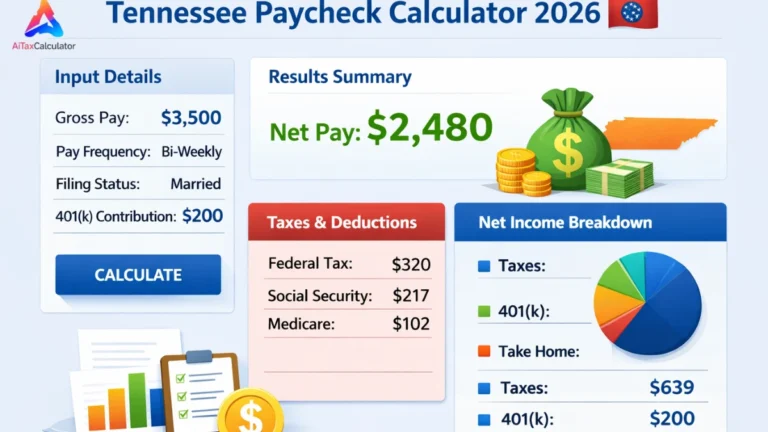
The Tennessee Paycheck Calculator helps employees accurately estimate their take-home pay after deductions. Tennessee does not charge state income tax on wages, making paycheck calculations simpler compared to other states. However, federal income tax, Social Security, and Medicare still apply.
Whether you are an hourly worker, salaried employee, or part-time professional, this Tennessee Paycheck Calculator provides fast and reliable results. It allows you to plan your monthly budget, verify payroll accuracy, and understand how deductions affect your net pay.
🎸 Tennessee Paycheck Calculator 2026
No state income tax on wages! Federal + FICA only · SS wage base $176,100 · Updated 2026
Calculate Tennessee Paycheck
Watch: How the Tennessee Paycheck Calculator Works
People moving to Tennessee for the first time — whether for Nashville’s booming job market, Memphis’s healthcare industry, Knoxville’s growing tech scene, or Chattanooga’s manufacturing corridor — all ask the same question within the first week: “How much of my paycheck do I actually keep?” The answer, compared to most other states, is genuinely good news. Tennessee is one of a small handful of states where your paycheck is not reduced by any state income tax on wages whatsoever.
This page explains exactly how a Tennessee paycheck works in 2026 — what comes out, what stays in, why Tennessee workers consistently take home more than counterparts in states like New York, California, or Illinois at the same salary level, and what you can do to keep even more of every dollar you earn. The Tennessee paycheck calculator at the top of this page handles the math instantly — this content explains the reasoning behind every number.
“A $70,000 salary in Nashville takes home approximately $53,500 to $55,000 per year — around $4,460 to $4,580 per month. In New York City, that same $70,000 salary delivers roughly $48,000 to $49,000 annually. The difference is almost entirely Tennessee’s zero state income tax on wages.”
— Based on 2026 federal, TN, and NYC tax calculations for single filers with no pre-tax deductionsTennessee Has No State Income Tax — Here Is What That Actually Means
Tennessee eliminated its state income tax on wages completely. The Hall Income Tax — Tennessee’s old investment income tax that taxed interest and dividends — was phased out gradually and fully repealed as of January 1, 2021. Since that date, Tennessee has had zero state income tax on any form of earned income, including wages, salaries, tips, bonuses, overtime pay, and commissions.
What this means for your Tennessee paycheck in 2026 is straightforward: the state line on your pay stub shows $0.00. Not a small amount. Not a reduced amount. Zero. Your Tennessee employer withholds nothing for state income tax because there is nothing to withhold. Every dollar that would have gone to a state tax department in California, New York, or Illinois stays in your paycheck in Tennessee.
However — and this is where many people get confused — Tennessee workers still pay federal income tax through the IRS, and they still pay FICA taxes (Social Security and Medicare) just like every other American worker. Tennessee’s tax advantage is entirely at the state level. Your federal tax bill in Tennessee is identical to what it would be in any other state at the same income level.
What Actually Comes Out of a Tennessee Paycheck in 2026
Even without state income tax, a Tennessee paycheck still has meaningful deductions. Understanding each one helps you read your pay stub accurately and plan your finances around your real take-home income rather than your gross salary.
Federal income tax is the largest single deduction for most Tennessee workers. It is calculated using the 2026 federal tax brackets — seven progressive brackets ranging from 10% on the lowest income up to 37% on income above $626,350 for single filers. The 2026 federal standard deduction is $15,000 for single filers and $30,000 for married couples filing jointly. Most Tennessee workers earning between $40,000 and $120,000 per year pay an effective federal rate somewhere between 12% and 20%.
Social Security tax is withheld at 6.2% of wages, but only up to the 2026 wage base of $176,100. Once your wages for the year hit $176,100, Social Security withholding stops for the rest of that calendar year — and your take-home pay gets noticeably larger in those final pay periods. For most Tennessee workers earning under $100,000 annually, Social Security is withheld on every paycheck throughout the entire year.
Medicare tax has no cap — it applies at 1.45% on all wages regardless of how much you earn. Higher earners above $200,000 per year (single) also pay an additional 0.9% Medicare surtax on wages above that threshold, automatically withheld by your employer once your year-to-date wages exceed $200,000.
Tennessee Paycheck — Real Take-Home Examples 2026
Tennessee vs High-Tax States — The Real Paycheck Difference
The paycheck advantage of living in Tennessee becomes most visible when you compare it side-by-side with a high-tax state at the same salary. Below is a direct comparison for a single filer earning $85,000 per year — showing monthly take-home pay in Tennessee versus New York City, one of the highest combined tax burdens in the country.
🏙️ New York City Resident
🎸 Tennessee Resident (Nashville)
At $85,000 per year, the Tennessee resident takes home $664 more per month than the NYC resident — that’s $7,968 more per year purely from lower taxes. Over a decade, that compounds to nearly $80,000 in additional take-home pay at the same gross salary, before accounting for any differences in cost of living between Nashville and Manhattan.
How Tennessee Compares to All No-Income-Tax States
Tennessee is one of only nine states with no broad-based state income tax on wages. But not all zero-income-tax states are identical — some have other payroll-adjacent taxes that affect your take-home pay in ways Tennessee does not.
| State | State Income Tax on Wages | Additional Payroll Taxes | Sales Tax | TN Advantage? |
|---|---|---|---|---|
| 🎸 Tennessee | $0 | None | 7% + local | Baseline |
| ⭐ Texas | $0 | None | 6.25% + local | Equal |
| 🦅 Florida | $0 | None | 6% + local | Equal |
| 🌲 Washington | $0 | WA Cares Fund 0.58% | 6.5% + local | TN slightly better |
| 🦅 South Dakota | $0 | None | 4.2% + local | Equal |
| 🏔️ Nevada | $0 | None | 6.85% + local | Equal |
| 🏔️ Wyoming | $0 | None | 4% + local | Equal |
| 🏔️ Alaska | $0 | None | 0% state | AK better (no sales tax) |
| 🌊 New Hampshire | $0 on wages | None on wages | 0% state | NH better (no sales tax) |
How to Keep Even More of Your Tennessee Paycheck
Tennessee already gives you a structural tax advantage by eliminating state income tax. But federal income tax still represents the largest single deduction from most Tennessee paychecks — and there are proven, legal strategies that significantly reduce your federal tax bill without any risk or complexity.
- Maximize your 401(k) or 403(b): The 2026 contribution limit is $23,500. Every dollar you contribute reduces your federal taxable income dollar-for-dollar. For a Tennessee worker in the 22% federal bracket, maxing out a 401(k) saves approximately $5,170 in federal income tax per year — money that stays in your retirement account instead of going to Washington.
- Open an HSA if you qualify: Health Savings Account contributions avoid federal income tax AND Social Security and Medicare taxes simultaneously. For 2026, the HSA contribution limit is $4,300 for individuals and $8,550 for families. Unlike a 401(k), HSA money can be withdrawn tax-free for qualifying medical expenses at any age.
- Use a Dependent Care FSA: If you pay for child care or elder care, a Dependent Care FSA allows you to contribute up to $5,000 per household on a pre-tax basis — reducing your federal taxable income by that amount.
- Enroll in pre-tax health insurance: Most employer-sponsored health plans allow premiums to be paid on a pre-tax basis, reducing your federal taxable wages. If your employer offers this, always elect the pre-tax option — it costs nothing extra and reduces every paycheck’s tax withholding.
- Understand your withholding: Filing a new W-4 with your employer can adjust your federal withholding to match your actual expected tax liability — preventing over-withholding that effectively gives the IRS an interest-free loan of your money all year.
How to Use the Tennessee Paycheck Calculator
Enter Your Gross Pay
Type in your gross pay for the pay period — this is your salary before any taxes or deductions are taken out. The calculator accepts any amount and works with weekly, bi-weekly, semi-monthly, monthly, quarterly, or annual pay frequencies.
Choose Pay Frequency
Select how often you receive a paycheck. Most Tennessee salaried employees are paid bi-weekly (26 times per year) or semi-monthly (24 times per year). Hourly workers are often paid weekly. The frequency determines your per-period deductions.
Select Filing Status
Your filing status — Single, Married Filing Jointly, Head of Household, or Married Filing Separately — determines which 2026 federal tax brackets and standard deduction apply. Married filers generally benefit from wider brackets at the same income level.
Add Pre-Tax Deductions (Optional)
Enter any pre-tax contributions: 401(k), health insurance premiums, dental and vision, or FSA/HSA deposits. These reduce your federal taxable income before tax is calculated — making your take-home pay higher than if you had no pre-tax deductions.
Read Your Results
Click Calculate and instantly see your Tennessee take-home pay, a complete line-by-line deduction breakdown, your effective federal tax rate, and annual salary totals. The Tennessee state tax line will always show $0.00 — because that’s exactly what Tennessee takes from your wages.
Tennessee Paycheck Questions — Real Answers
Yes — completely. Tennessee eliminated its Hall Income Tax (which taxed investment income like dividends and interest) fully as of January 1, 2021. Tennessee has never had a broad income tax on wages, and as of 2021 it has no income tax of any kind on any personal income. In 2026, your Tennessee paycheck reflects zero state income tax withholding — not a reduced rate, not a partial exemption, but literally zero.
This is permanent under current law. Tennessee’s state constitution has historically been interpreted as prohibiting a general income tax on earned wages, and there is no serious legislative movement to change this in 2026 or the foreseeable future.
For most Tennessee workers, total paycheck tax deductions in 2026 run between 18% and 28% of gross income — significantly lower than comparable workers in high-tax states. The breakdown for a single filer earning $70,000 per year is approximately: federal income tax 12–14% effective rate, Social Security 6.2%, Medicare 1.45%, and Tennessee state tax 0%. Total effective deduction rate: roughly 20–22%.
Compare this to a single filer in New York City earning the same $70,000 — their total effective deduction rate including federal, NY state, and NYC taxes would be approximately 30–34%. The 10-12 percentage point difference is substantial and represents thousands of dollars per year in take-home pay.
On a $60,000 annual salary as a single filer in Tennessee with no pre-tax deductions, your approximate 2026 take-home pay is $46,200 to $47,400 per year — roughly $3,850 to $3,950 per month. This includes federal income tax of approximately $5,800 per year (effective rate ~9.7%), Social Security of $3,720, and Medicare of $870. Tennessee state tax: $0.
If you contribute $400/month ($4,800/year) to a 401(k) and pay $250/month in pre-tax health insurance, your federal taxable income drops significantly — and your monthly take-home could actually be comparable at around $3,700–$3,800 while simultaneously building retirement savings and covering health costs.
Tennessee does not tax Social Security benefits, pension income, retirement account distributions, or any other form of income at the state level — because Tennessee has no state income tax of any kind as of 2026. This makes Tennessee an exceptionally retirement-friendly state from a tax perspective.
However, retirees in Tennessee still owe federal income tax on Social Security benefits (up to 85% is taxable at the federal level for higher-income recipients), federal tax on pension distributions, and federal tax on traditional IRA and 401(k) withdrawals. The state tax relief is significant, but it does not eliminate federal obligations.
No. Neither Nashville, Memphis, Knoxville, Chattanooga, nor any other city in Tennessee levies a local income tax on wages. Tennessee law prohibits local governments from imposing income taxes, which means your Tennessee paycheck has no city or county income tax deduction regardless of where in the state you live or work.
This contrasts sharply with states like Ohio (where Columbus and Cleveland levy city income taxes), Kentucky (where Louisville levies a local occupational tax), or New York (where NYC residents pay city income tax of up to 3.876%). Tennessee workers in every city and county benefit equally from this protection.
Your bonus is subject to the same taxes as your regular wages in Tennessee — federal income tax and FICA (Social Security and Medicare). Tennessee takes nothing at the state level. However, your employer will likely withhold federal tax on your bonus using the IRS supplemental wage withholding rate of 22% (for bonuses under $1 million), which can make your bonus paycheck look like it was taxed at a higher rate than usual.
This is a withholding method, not a permanent higher tax rate. When you file your annual federal tax return, your total income — including the bonus — is taxed at your actual marginal bracket rates. If the 22% flat withholding resulted in over-withholding compared to your actual bracket, you receive the difference as part of your federal refund. Your effective tax rate on the bonus is ultimately the same as on your regular wages.
Official Sources & References
- Tennessee Department of Revenue — Official confirmation of Hall Tax repeal and current TN tax obligations
- Internal Revenue Service (IRS.gov) — 2026 federal income tax brackets, standard deductions, withholding guidance
- Social Security Administration — 2026 Social Security taxable wage base ($176,100)
- Tax Foundation — State income tax rate comparisons and Tennessee tax profile
- IRS Publication 15 (Circular E) — Employer’s Tax Guide for 2026 withholding
🎸 Calculate Your Tennessee Paycheck Now
Use the free Tennessee paycheck calculator at the top of this page. Enter your salary, choose your frequency and filing status, add any pre-tax deductions — and see your exact 2026 take-home pay in seconds. The state tax line will confirm what Tennessee already told you: $0.00.
🔗 More Paycheck Calculators by State
Free paycheck calculators updated for 2025–2026
Final Thoughts
The Tennessee Paycheck Calculator is a reliable and easy-to-use tool for estimating your 2026 take-home pay. With no state income tax on wages, this calculator helps you focus on federal deductions and better financial planning. Use it regularly to stay informed and in control of your income.