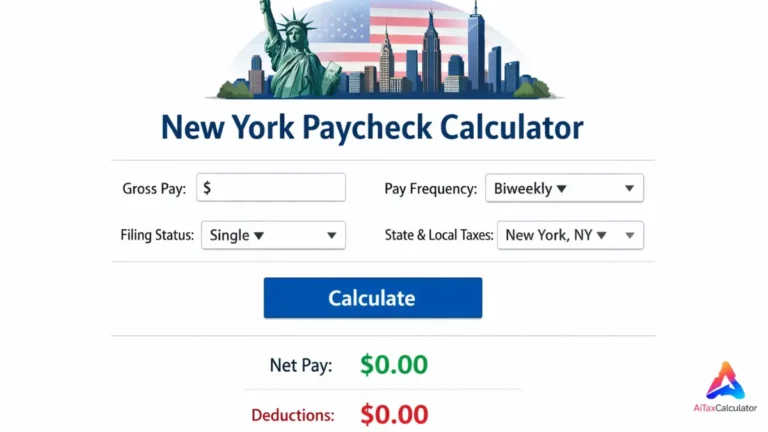
Our New York Paycheck Calculator helps employees and freelancers estimate their take-home pay after taxes. Simply enter your gross salary, pay frequency, and filing status to calculate federal tax, New York state tax, and local deductions. This free tool gives a quick and accurate estimate of your net paycheck so you can plan your monthly budget and understand how much money you will actually receive after taxes in New York.New York Paycheck Calculator – Estimate your take-home pay after federal, state, and NYC taxes. Use our free New York paycheck calculator to calculate salary, deductions, and net income instantly.
🗽 New York Paycheck Calculator 2026
Calculate your exact NY take-home pay with state tax, NYC city tax, FICA, SDI & Paid Family Leave.
Updated for 2026 tax year — accurate 9-bracket NY state rates.
Enter your gross pay and click
Calculate New York Paycheck
Results appear here instantly
Let’s be honest — when someone in New York gets a job offer for $75,000, the first thought is usually excitement. The second thought, about thirty seconds later, is: “But how much do I actually take home?” That gap between what your employer pays you and what lands in your bank account is bigger in New York than almost anywhere else in the country. And for people living in New York City specifically, that gap is one of the widest in the entire United States.
This page exists to close that gap — to explain, in plain English, exactly how a New York paycheck gets calculated in 2026, where every dollar goes, why New York City residents lose more than upstate New Yorkers, and what you can realistically do to keep more of what you earn. The New York paycheck calculator at the top of this page handles the math — this content explains the logic behind every number it produces.
“A $75,000 salary in Manhattan, after all taxes, delivers roughly $50,000 to $52,000 in annual take-home pay — about $4,200 per month. Before you sign any lease in the city, that’s the number you need to plan around.”
— Based on 2026 NY State, NYC, and Federal tax calculations for single filersWhy Your New York Paycheck Looks Nothing Like Your Salary
New York is the only state in the country where a regular salaried employee can have seven separate deductions taken from a single paycheck before they ever see a dollar. Most states have three or four. New York has seven — and if you live in New York City, those seven deductions combine into one of the highest paycheck tax burdens in the entire United States.
Here is what actually comes out of a New York paycheck in 2026, in the order your employer calculates it:
First, your employer subtracts any pre-tax deductions — things like your 401(k) contribution, health insurance premium, dental and vision coverage, and FSA or HSA deposits. These reduce your taxable income before a single tax is calculated, which is why contributing to a 401(k) immediately lowers your tax bill on both the federal and state level simultaneously.
Second, federal income tax is withheld based on 2026’s seven tax brackets, ranging from 10% up to 37%. For most New Yorkers earning between $45,000 and $150,000 per year, the effective federal rate lands somewhere between 12% and 22% — meaning your marginal rate is higher than what you actually pay overall.
Third, New York State income tax is calculated separately using its own nine-bracket system that runs from 4% up to 10.9%. The 10.9% rate only kicks in on income over $25 million, so the vast majority of New Yorkers pay an effective state rate somewhere between 4% and 7%, depending on income and filing status.
Fourth, if you are a New York City resident — and only if you actually live within the five boroughs — the city takes its own cut: an additional 3.078% to 3.876% in city income tax. This is the deduction that surprises most people who move to the city for the first time and wonder why their first NYC paycheck is so much smaller than their last paycheck from wherever they came from.
Fifth and sixth, Social Security (6.2% on wages up to $176,100 in 2026) and Medicare (1.45% on all wages, plus 0.9% extra once you earn over $200,000 annually) are withheld as FICA taxes — these are federal and apply the same way in New York as everywhere else.
Seventh, two New York-specific mandatory deductions round out the list: New York State Disability Insurance (SDI), capped at just $0.60 per week, and New York Paid Family Leave (PFML), which runs at 0.388% of wages in 2026 up to a maximum of $333.25 for the year. These are small individually, but they are mandatory and many New Yorkers don’t even know they exist until they look closely at their pay stub.
New York State Income Tax in 2026 — The 9-Bracket System Explained
New York State uses a progressive income tax system — the same principle as the federal system — where your income is divided into chunks, and each chunk is taxed at a progressively higher rate. What this means in practice is that your effective tax rate (what you actually pay as a percentage of total income) is always lower than your marginal tax rate (the rate on your highest dollar of income).
For 2026, New York has nine income tax brackets. The standard deduction — the amount subtracted from your gross income before any tax is calculated — is $8,000 for single filers and $16,050 for married couples filing jointly. So if you earn $60,000 as a single filer, your New York taxable income is $52,000 after the standard deduction. That $52,000 is what the brackets below apply to — not your full $60,000 salary.
New York State Tax Brackets 2026 — Single Filers
| NY Taxable Income (Single) | NY Tax Rate | What You Actually Pay on This Portion | Level |
|---|---|---|---|
| $0 – $17,150 | 4.00% | Max $686 on this bracket | Entry |
| $17,151 – $23,600 | 4.50% | Max $290 on this bracket | Low |
| $23,601 – $27,900 | 5.25% | Max $226 on this bracket | Low |
| $27,901 – $161,550 | 5.85% | Max $7,822 on this bracket | Middle — most NY earners land here |
| $161,551 – $323,200 | 6.25% | Max $10,103 on this bracket | Upper Middle |
| $323,201 – $2,155,350 | 6.85% | Max $125,518 on this bracket | Upper |
| $2,155,351 – $5,000,000 | 9.65% | Max $274,483 on this bracket | High |
| $5,000,001 – $25,000,000 | 10.30% | Max $2,060,000 on this bracket | Top |
| Over $25,000,000 | 10.90% | No cap | Top |
Notice that the bracket most New Yorkers actually live in is 5.85% — the range from $27,901 to $161,550 of taxable income. Someone earning $90,000 gross, after the $8,000 NY standard deduction, has $82,000 in taxable income. Most of that $82,000 falls in the 5.85% bracket. Their effective NY state rate ends up around 5.3% to 5.5%, not the 5.85% marginal rate — because the first $27,900 was taxed at lower rates.
Married Filing Jointly — NY State Tax Brackets 2026
| NY Taxable Income (Married Filing Jointly) | NY Tax Rate | Level |
|---|---|---|
| $0 – $27,900 | 4.00% | Entry |
| $27,901 – $43,000 | 4.50% | Low |
| $43,001 – $161,550 | 5.25% | Low-Middle — most MFJ households |
| $161,551 – $323,200 | 5.85% | Middle |
| $323,201 – $2,155,350 | 6.25% | Upper Middle |
| $2,155,351 – $5,000,000 | 6.85% | Upper |
| $5,000,001 – $25,000,000 | 9.65% | High |
| Over $25,000,000 | 10.90% | Top |
The NYC City Tax — What It Really Costs to Live in the Five Boroughs
The New York City income tax is the deduction that catches most people off guard when they move to the city. It is a completely separate tax from the New York State income tax, calculated on the same income, and it applies exclusively to people who legally reside in New York City — meaning Manhattan, Brooklyn, Queens, The Bronx, or Staten Island.
If you commute into the city from New Jersey, Westchester, Long Island, or Connecticut, you owe zero NYC city tax — regardless of how many hours you spend working there. The tax is based entirely on where you sleep at night, not where you work. This is why you will find so many finance and law professionals who work in Midtown but live in Hoboken, Montclair, or Greenwich — the math works out meaningfully in their favor.
The NYC income tax rates for 2026 run from 3.078% on the first $12,000 of city taxable income up to 3.876% on income above $50,000 for single filers. For most working New Yorkers earning between $50,000 and $200,000, the effective NYC rate is approximately 3.6% to 3.8%.
NYC Tax — What It Actually Costs Per Year
The side-by-side comparison above makes the NYC tax impact concrete. At $110,000 per year, living in New York City costs you roughly $342 extra per month compared to someone earning the same salary in upstate New York or Long Island — that’s $4,104 per year in additional city income tax. Over five years, that’s over $20,000.
NYC Resident vs. Commuter — The Real Tax Difference at $100,000
This is one of the most common financial comparisons people make when they take a job in New York City: is it worth paying for the convenience of living in the city, or does the math strongly favor a suburban commute?
🏙️ Lives in Brooklyn (NYC Resident)
🏡 Lives in White Plains (Commutes to NYC)
The commuter takes home $3,754 more per year purely because they live outside city limits — that is the direct cost of the NYC city income tax at $100,000 salary. Of course, the commuter from White Plains likely has Metro-North train costs ($2,500–$4,000+ annually depending on zone), so the true financial comparison is nuanced. But the tax difference itself is real and significant.
NY SDI and Paid Family Leave — The Two Deductions Nobody Explains
Check your last New York pay stub carefully. Somewhere between the Social Security line and the Medicare line, you will find two small deductions that most people either ignore or have never heard explained: NY SDI and NY PFML. They are mandatory, they apply to almost every New York employee, and together they represent part of what makes a New York paycheck uniquely different from paychecks in most other states.
New York State Disability Insurance (SDI) has been around for decades. Employees contribute 0.5% of their weekly wages, capped at a maximum of $0.60 per week. That cap means no New York employee ever pays more than $31.20 per year into SDI — less than $3 per month. In exchange, if you become unable to work due to a qualifying non-work-related illness or injury, you can receive SDI benefits of up to $170 per week for up to 26 weeks. It is a small premium for meaningful short-term protection.
New York Paid Family Leave (PFML) is newer, more substantial, and often misunderstood. For 2026, the employee contribution rate is 0.388% of gross wages, with a maximum annual contribution of $333.25. Once you hit that cap — which happens around mid-year for employees earning above $85,000 — no further PFML deductions are taken for the rest of the year. PFML entitles qualifying employees to take up to 12 weeks of paid, job-protected leave at 67% of the New York statewide average weekly wage — which in 2026 translates to a maximum weekly benefit of approximately $1,177.
Social Security and Medicare Withholding in New York for 2026
FICA taxes — the combination of Social Security and Medicare — are federal taxes that work exactly the same way in New York as they do in every other state. But they deserve a clear explanation because they represent a significant portion of any New York paycheck deduction, particularly for middle and higher earners.
Social Security is withheld at 6.2% of wages up to the annual wage base cap. For 2026, that cap is $176,100 — up from $168,600 in 2025. What this means practically: if you earn $176,100 or less in 2026, you pay 6.2% on every dollar. If you earn $200,000, you pay 6.2% on the first $176,100 (capped at $10,918), and nothing on the remaining $23,900. Once you hit the cap mid-year, your paycheck gets noticeably larger — which surprises many higher earners the first time it happens.
Medicare works differently — there is no wage base cap. All wages are subject to the 1.45% Medicare tax, regardless of how much you earn. Additionally, individuals earning more than $200,000 per year (single filers) are subject to the Additional Medicare Tax of 0.9% on all wages above that threshold. Your employer automatically starts withholding the additional 0.9% once your wages surpass $200,000 in a calendar year, even if your household income is lower when combined with a spouse’s earnings on a joint return.
How to Actually Lower Your New York Paycheck Tax — Not Theory, Real Numbers
There is no shortage of vague advice online about “maximizing pre-tax contributions” and “reducing your taxable income.” But what does it actually mean for your New York paycheck in dollar terms? Let’s look at real numbers for a single filer earning $85,000 per year in New York City.
Scenario A — No Pre-Tax Contributions: Gross $85,000, federal taxable income after $15,000 standard deduction = $70,000. NY taxable income after $8,000 deduction = $77,000. Monthly take-home in NYC: approximately $4,620.
Scenario B — Max 401(k) + Health Insurance: Same $85,000 salary, but contributing $23,500 to a 401(k) and paying $500/month in pre-tax health premiums ($6,000/year). Federal taxable income drops to $40,500. NY taxable income drops to $55,500. Monthly take-home in NYC: approximately $4,440 — but you are also putting $1,958/month into retirement savings and receiving health coverage. Your actual disposable income is structured very differently, and you have paid substantially less in federal and state income tax.
The reason maxing your 401(k) feels counterintuitive is that your take-home pay often goes down slightly even as your total compensation picture dramatically improves. For every $1,000 you put into a 401(k), your New York City paycheck typically only drops by about $600–$680 — because the other $320–$400 was going to taxes anyway. You are essentially redirecting money from the government to your own retirement account.
— This is why financial advisors consistently call 401(k) contributions one of the highest-return financial moves available to New York employees
Beyond retirement accounts, Health Savings Accounts (HSAs) offer the single best tax treatment of any account available to American workers — contributions avoid federal income tax, New York State income tax, AND FICA taxes simultaneously. For a New York City resident in the 22% federal bracket and 5.85% NY bracket paying the 3.876% NYC rate, each dollar contributed to an HSA effectively saves approximately 37–38 cents in combined taxes in 2026.
Questions Real New Yorkers Actually Ask About Their Paychecks
For a single filer earning $90,000 per year living in New York City, your approximate monthly take-home pay in 2026 is around $5,150 to $5,350 per month, assuming no pre-tax deductions like a 401(k) or health insurance.
Here is roughly how that breaks down per month: Federal income tax takes about $854, New York State income tax takes about $390, NYC city tax takes about $278, Social Security takes about $465, Medicare takes about $109, and NY SDI plus PFML takes about $18. Total monthly deductions: roughly $2,114, leaving approximately $5,386 in take-home pay.
If your employer offers a pre-tax 401(k) and health insurance plan, enrolling in both can bring your monthly deductions down by $200–$400 and increase your take-home — while simultaneously building retirement savings and covering health costs. Use the New York paycheck calculator above to run your exact numbers with your specific deductions.
If you live in New York City and she lives in New Jersey, then yes — she almost certainly takes home more money per paycheck, even at the same gross salary, and the reason is simple: she does not pay New York City income tax.
At a $95,000 salary, the NYC city tax alone costs you approximately $3,500–$3,700 per year. Your New Jersey colleague pays New Jersey state income tax instead — which at that income level is roughly similar to or slightly lower than NY state tax. The big gap is the absence of the NYC city tax in her calculation.
Of course, she may be paying $2,500–$4,500 per year in NJ Transit or train costs, depending on where she lives, which offsets some of the tax advantage. But purely from a paycheck withholding standpoint, your NYC address is costing you real money every two weeks.
Once your wages for the year exceed $176,100 — which for a $200,000 earner typically happens sometime in October or November — your employer automatically stops withholding the 6.2% Social Security tax for the rest of that calendar year.
What this means practically is that your paycheck gets noticeably larger for those final weeks of the year. At 6.2%, once you are past the cap, each paycheck is effectively $0.062 × your per-period wage larger than it was during the earlier part of the year. For a biweekly pay period at $200,000 salary, that is roughly $477 more per paycheck in take-home pay for those final few pay periods of 2026.
Medicare withholding never stops — it continues at 1.45% on all wages throughout the year with no cap. And if your total wages exceed $200,000, the additional 0.9% Medicare surtax also continues regardless of the Social Security cap.
New York State is considerably more generous with retirement income than it is with wage income — though this advantage disappears if you retire in New York City, where the city tax still applies.
Social Security benefits are completely exempt from New York State income tax — no matter how much you receive. This is a significant benefit compared to the federal government, which taxes up to 85% of Social Security for higher-income recipients.
Pension income from New York State, local government, and federal government employment is also fully exempt from NY state tax. If you are a retired teacher, firefighter, police officer, or federal employee, your pension is not taxed at the state level in New York.
For private pensions and IRA distributions, New York allows an exclusion of up to $20,000 per year for individuals who are 59½ or older. Income above that exclusion is taxable at the normal NY state rates. The main caveat: all of this still applies the NYC city tax if you live within the five boroughs in retirement.
The tax rates themselves are identical — the same federal brackets, the same NY state brackets, the same NYC tax, and the same FICA rates apply whether you earn an hourly wage or an annual salary. The difference is in how the annualization works.
For salaried employees, the math is straightforward: take your annual salary, subtract standard deductions and pre-tax contributions, apply the brackets, then divide by your number of pay periods per year.
For hourly workers, the annualization depends on the number of hours worked. If your hours vary week to week, your tax withholding will also vary — more hours means more withholding in that specific paycheck. Overtime pay is taxed at the same marginal rate as your regular wages in New York — there is no special lower rate for overtime, despite what some people believe.
Hourly workers in New York who have highly variable schedules sometimes end up over-withheld or under-withheld over the course of the year, which is why some hourly employees in New York end up with larger-than-expected refunds — or unexpected tax bills — in April.
Your bonus income is taxed at the same federal and New York State rates as your regular wages — there is no special “bonus tax rate.” However, your employer typically withholds taxes on bonuses differently, which creates the common illusion that bonuses are taxed at a higher rate.
The IRS allows employers to use the flat rate method for supplemental wages like bonuses — withholding a flat 22% for federal taxes (for bonuses under $1 million). New York State also uses a flat supplemental withholding rate of 11.7% for state tax on bonuses. NYC adds its own withholding on top of that.
The result is that a large bonus often looks like it is taxed at a much higher rate than your regular paycheck. But when you file your annual tax return, everything gets reconciled at your actual marginal rates — so if you were over-withheld on the bonus, you receive that back as part of your refund. The bonus itself is not permanently taxed at a higher rate, even though the withholding in the pay period of the bonus may look alarming.
Sources & Official References
- New York State Department of Taxation and Finance — 2026 income tax brackets, withholding tables, standard deduction amounts, and NYS filing requirements
- NYC Department of Finance — New York City personal income tax rates and bracket structure for 2026
- NY Paid Family Leave Program — 2026 employee contribution rate (0.388%), annual maximum ($333.25), and benefit details
- Internal Revenue Service — 2026 federal income tax brackets, standard deductions, and FICA withholding guidance
- Social Security Administration — 2026 Social Security taxable wage base ($176,100)
- NY Workers Compensation Board — New York State Disability Insurance contribution rates and benefit amounts
🗽 Ready to See Your Exact New York Paycheck?
Every number on this page was built into the New York paycheck calculator sitting at the top. Enter your salary, choose your pay frequency, toggle the NYC tax on if you live in the five boroughs, add any pre-tax deductions you make — and you will see exactly what your 2026 New York paycheck looks like, line by line, before it ever hits your bank account.
🔗 More Paycheck Calculators by State
Free paycheck calculators updated for 2025–2026